Saturday, October 8, 2011

Saturday, Snow & Shopping

First of all, hurrah for Saturday of a three-day weekend!  It's off to a pretty start, too.  This is what I saw from the window this morning:


Except for, perhaps, when the fireweed is in full bloom, Kotzebue is prettiest when there's a layer of freshly fallen snow over everything!  I was wondering when it would snow.  Actually, it did snow just a little earlier this week, Thursday morning, I think, but it didn't cover the ground and was gone by mid morning.  However, even that seemed late.  Of course, I'm only going into my third winter here, but based on what other people say, the first snowfall usually happens in September.  Not this year.  I was trying to find some historic weather data for Kotzebue, but was unsuccessful.  I did find some interesting summaries for Anchorage.  I think Kotz would be fairly different, though.  There would be a lag in temps and begin/end dates, for sure.  Anchorage probably gets much more snowfall as well.  The amount of snowfall in Kotzebue isn't much.  We meet the definition of a cold desert, a desert having < 9 inches annual precipitation.  Just for reference, though, here's what I found for earliest and latest dates for first snowfall in Anchorage.  The entire page can be seen here.


My neighbor is into yard sales and always finds out if there are any and where to they are (addresses are a different animal here; I'll write on that another time).  Last week there were none, and I thought with the weather getting colder, and now with snow starting to fall, that we had probably seen the last of them until spring.  Space is a premium here, though, so if you have to get rid of things, you find a way.  There were, indeed two sales.  One was inside.  I got a little knife for free that I'll add to my survival kit.  The other one was outside, and I picked up a few hangers.  


Now I have to take advantage of this Saturday of a three-day weekend and use those hangers to do some long-awaited cleaning and organizing.  This snow won't stick around, but it's usually here for good before Halloween, and I have to be able to get to my boots and snow pants!

Here We Are Again

 It's that time of year again.  I'm traveling to villages; the goal is 9 or 10 within the school year.  I've done 2 so far and will have 3 more before Christmas.  This is my 3rd year, and I'm getting more and more requests.  My first visit this year was to Kiana, which also happened to be one of the later visits last school year, so I was just there this spring.  It was nice to get to see the village during different seasons.


On this visit, the teachers asked me to stay the whole week.  I arrived Monday, at a very busy time as you can see from the crowded airport picture below, and stayed through Friday evening.


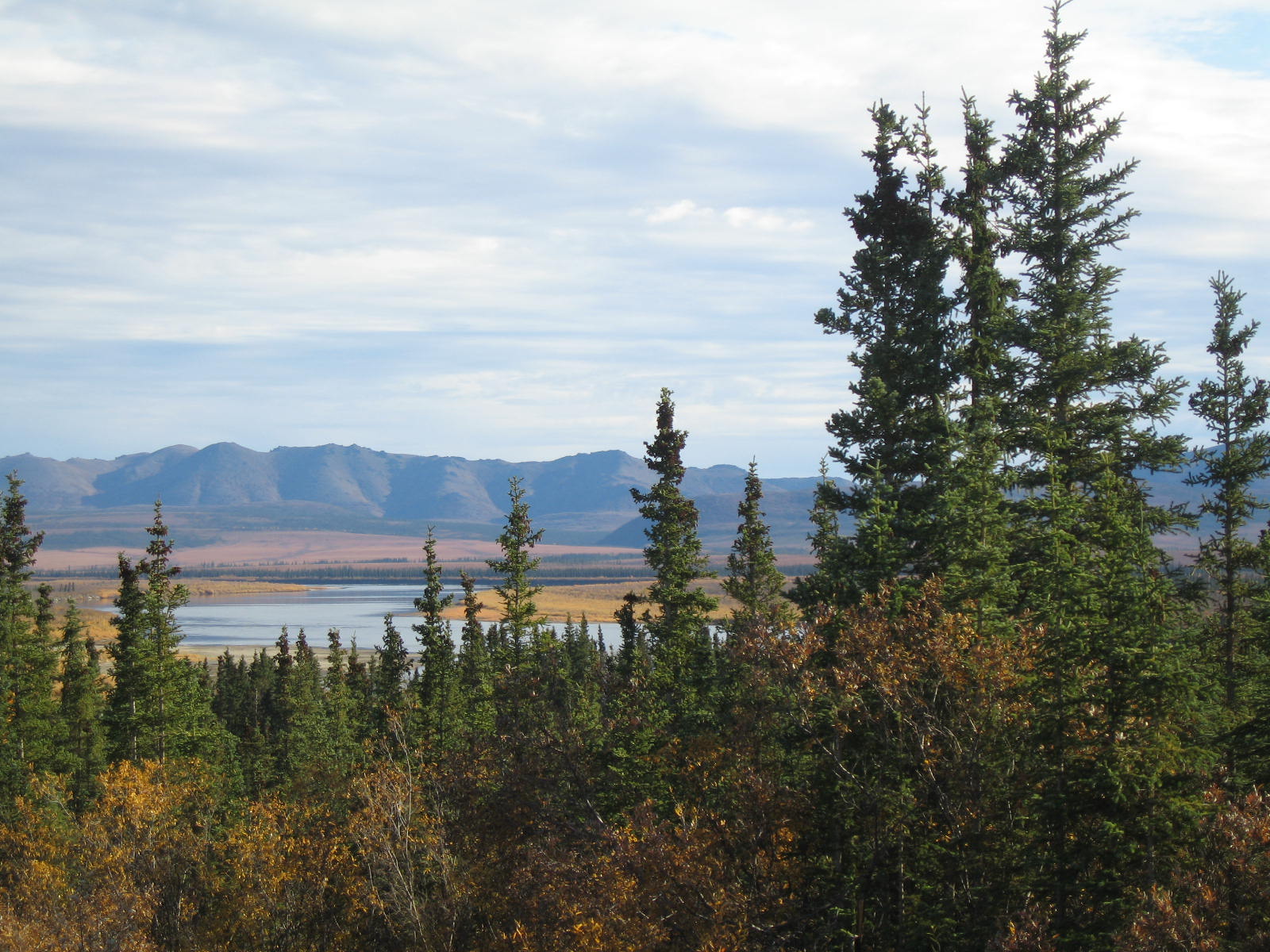
I had probably missed the really pretty fall colors by several weeks, but there was plenty of pretty green and gold contrast with the spruce and paper birch.


Kiana has an interesting history.  It's situated where the Squirrel and Kobuk rivers come together.  The name came from the Inupiaq word Qayaana, which to my best understanding refers to a point of land across the river from the village.  The natives tended to call the place Katyaak which means where the rivers meet, but English speaking folks around 1900 heard them saying, "qayaana katyaak," and called it Kiana.  There's a neat website with lots of cultural info about Kiana.  Go to Kiana Jukebox to learn more about Kiana.


The reason there were lots of English-speaking people in Kiana around 1900 is a story in itself.  You might know that was during the time of gold rushes all around Alaska, the biggest being the Klondike (in Canada but accessed through AK).  Shortly after the Klondike rush, it was reported that gold was found on the Kobuk, and about 2000 prospectors arrived to Kotzebue in July, 1898.  When they arrived, locals informed them that the rumors were lies, and over half turned around and went home.  About 800, however, made their way upriver and spent the winter.  They didn't find anything, but eventually there was some gold found over the next 10 years in a few tributaries of the Kobuk, including Squirrel River, which joins the Kobuk right at Kiana.  To read more, start at this NPS website.

Here are a few more pictures to enjoy:


Kiana Lynx gym

Friday, September 23, 2011

Mosquito Haven 1/2 Marathon

Last December I made a decision to alter my habits and drop some weight.  I stopped drinking any sodas (called pop here), spent more time in my kitchen, and started working out.  I didn't dive into it by any means.  The food from my kitchen wasn't necessarily your typical diet food, but I controlled my portions. As often as I could, I logged it in some software that tracks nutrition, weight, and workout info.  The workouts started with just walking, and not super fast at that.  Little by little, I cranked up the workouts.  The food was always hit or miss, but I did go for months without eating out.  The weight was dropping steadily.  Around the new year, I decided that I would resolve to run in the annual Mosquito Haven Half Marathon held here in early August.  There was a lot of work to do to get ready.  I did start running and was getting much better.  Of course, this was on the treadmill because it was the middle of winter.  As spring thaw arrived and I started running on gravel, I realized I had much more work to do!  The hills and the gravel take much more energy than the treadmill.

Then summer arrived.  The school year is busy enough, but it seems that there is indeed a trend for an even busier summer.  You would think I would be able to be more active and lose more in the summer, but between a busy work schedule (which leads you to eat quick, easy, calorie laden food) and doing things that are outdoors but not physically demanding (going to a cookout on the beach, berry picking, etc.) you run out of time to dedicate to fitness.  I noticed quickly that I was putting some weight back on.  I was disappointed but still determined to keep my resolution.


People can participate in the half marathon by walking, biking or running.  Anyone who participates receives a light jacket like this one.  At the end they also give prizes to the first finisher in each category by age class, and there's a raffle for lots of other prizes.


I decided well before the event that I was not in shape to run it this year, but I could still walk it and work on running it next year.  So, I did walk.  About two thirds of the way through I caught myself thinking that even if I hadn't undone much of my hard work during the summer, I still would not have been able to run it yet.  Thirteen plus miles on gravel and hills is not easy!


So, walk it I did.  There's the proof, and there's my time.  Unfortunately, throughout the rest of August I continued to undo my work.  The first two weeks of August were so busy with organizing our Camp Willow (which fell through due to weather this year -- very disappointing), the last couple of Junior Ranger programs, working on a teacher workshop and being available during teacher inservice.  I found myself pulling a couple of all-nighters just to get things done.

After two weeks of "vacation"  (just kidding PEL & MEL!), I came back to dive into school programs and village visits.  The first, Kiana, asked me to stay the entire week.  That's great.  That means I have something they're looking for.  However, it's not easy to be healthy on these trips.  I stay in the school.  I might have access to a fridge or a place to cook something.  However, I have to travel as light as I can because I'm hauling boxes of props and program materials, so I can't bring my whole kitchen with me.  Whatever I take has to be lightweight, compact, and able to withstand being thrown around in the back of a little plane.  It's usually something like jerky, crackers and cheese.  This time I took some tuna packets and pilot bread.

The room I stayed in this year in Kiana looked like this:

It had been turned into a fitness room.  I thought that might be a big hint!  I did have time to use the equipment.  However, since I try to pack light, I usually only take 1 uniform, 1 change of clothes for the evening, and I wear my uniform boots the whole time.  This room was originally a special ed room, and it has a bathroom with a shower off of it, so I could take a shower, but there's no way to wash and dry clothes.  So, I didn't use the equipment.

Now I've been back in Kotz for the week, and I'm leaving for Noorvik on Monday.  That's the way it will be the majority of the school year.  Travel and in town on and off.  I know what I can do, though.  I felt and looked so much better earlier this year.  I just have to pick one of these days and make a choice.  It might as well be TODAY.  So, first steps:  1) stop the sodas effective immediately, water consumption must increase 2) going to the gym starts tomorrow morning 3) by the time I return from Noorvik, the eating out will be at a minimum.

If you're so inclined, make your own good choice with me!

Wednesday, September 7, 2011

Great Kobuk Sand Dunes

After 2 years working at Western Arctic National Parklands, I finally could say on August 8, that I have been on the ground in all four parks.  The whole interpretation division (5 of us) flew out to the Great Kobuk Sand Dunes which are 25 square miles of sand dunes in Kobuk Valley National Park.  The dunes formed from wind-blown deposits after the last glaciers receded.  They used to cover a much larger area, but the vegetation is steadily establishing itself and encroaching.

We flew to the Kobuk River in float planes that hold the pilot and up to 3 passengers.  From a certain point on the river, we hiked south to the dunes.

From the river, you hike uphill a bit through spruce forest.  It's fairly thick through part of the way, and there are patches of tussock tundra to cross.  We took our time, looked around, and stopped frequently, and it took a little over 2 hours.  Here are some shots along the way.


I didn't take enough pictures along the way.  Probably the last mile before reaching the dunes, the trees opened up, and there were birch and aspen (I think) in addition to the spruce.  You can almost see in this picture the ground covered with lichen.  It was a nice, easy walk.  Since there was a big group of us, we were making plenty of noise, but this is bear country, and you definitely don't want to surprise one.  We didn't.  We didn't see any wildlife.  Since we were following some GPS waypoints, we knew we were close to the dunes, but when you arrive, it's quite dramatic.  You're walking through the trees, and all of a sudden, you see a wall of sand.  It's a bit of a scramble to get to the top of that wall, but when you do, you see...
this!

Here are a few more pictures:

The wall of sand


See the ripples?

quaking aspen


quaking aspen taking hold


looks flat, but it's not
The dunes are formed by wind, and it was a bit of a windy day, so everything was gritty.  You might wonder how plants can grow in the middle of this sand.  It was interesting that just a couple of inches below the surface, the sand was wet and compacted.  Plants like the quaking aspen can get what they need to survive, and their roots stabilize the sand.  Then dead plant parts begin to form a layer of soil, and other plants begin to grow alongside.  This is how the sand dunes become vegetated.  See the Kobuk Valley National Park website for more information.

It was a really nice day out there.  It drizzled on and off and was overcast and windy, but that kept the walk out nice and cool.  During the summer, some people come up to float down the Kobuk River, so this is the kind of trip they could make.  If you have the money, there are a couple of companies authorized to fly visitors to the dunes.  You could either fly in on a float plane like we did or land on other places around the dunes with wheels.  If you have the chance, it's worth it.  Kobuk Valley National Park is one of the least visited national parks, so it's not something that most people will see.

Saturday, September 3, 2011

Cape Espenberg

I'm still seriously playing catch-up here. Let's go back to mid-July. I had the opportunity to spend some time on the ground in Bering Land Bridge National Preserve at Cape Espenberg.


One of the regional archeologists started a mentorship program for high school students that allows them to work on a dig in one of the parks for 10 days and be paid. She couldn't go out in the field with them this summer, so she contacted me to be their mentor. The archeologists on site taught them the archeology. I just had to travel with them and make sure they got up for work (which was more difficult than you might think).

There were 4 boys & 1 girl. Most were from local villages with 1 from Anchorage, but his grandparents live in Kotzebue.


As you might infer, it was buggy at times! We had a good mix of weather, though, and the kids all had a good time.


We all met in Nome then flew to Shishmaref, an endangered village on a sand spit on the Bering Sea. From there the arch site was a 3 hr boat ride up the coast to the north point of the Seward Peninsula.


This whale skull has marked the point for as long as anyone alive can remember.


Once we arrived, we all added our tents to the small village already formed by the archeologists.


An amazing cook, Rae, provided food for everyone in camp, which ranged between 20 - 30 people.


Everyone else, including the students, took turns helping out.


The rest of the day we all spent our time digging


and screening


and measuring


and uncovering artifacts


and cleaning and sorting in the lab tent.


The kids worked hard but ate well.


The biggest challenge of our time out there may have actually been these little guys! The ground squirrels ruled that turf and even chewed through a few tents to prove it.


The kids had fun, but I think we were all ready to go home. They were eager to get ahold of some sodas, and everyone wanted a shower!
- Posted using BlogPress from my iPod

Friday, August 19, 2011

Happy Belated Birthday -- USA

I looked back through my posts on this blog, and I skipped July 4th last year.  It's always a busy day because NPS staffs a booth at the fairground.  I did blog about it back in 2009, but I was using a different blogging site then.  Here's a link to it.  Frostbytes on Tumblr

The novelty of some of the events has worn off, or maybe it's that I have to spend the day in my uniform because I work part of the time at our booth, but I didn't watch as many of the activities this year.  I did happen to catch the opening ceremonies.  Of course John Baker (2011 Iditarod winner) was the grand marshal.

John Baker's trophy

Another thing that happens, that I'm not typically a fan of, are the various pageants -- Miss Arctic Circle, Teen Arctic Circle, Miss Maniilaq, etc.  The redeeming quality of these pageants is that the girls are actually covered, head to toe.  What covers them is what I enjoy getting to see.  They borrow parkas from friends or relatives, very nice and often very old parkas.  They're amazing to see, and the photos don't do justice.


Oh, and don't forget the mukluks on their feet.  Beautiful craftsmanship!  On this day, those girls were happy to have the warm parkas on; it was cold and windy.

I didn't watch any of the other events this year, but while I was at the Park Service booth, there were a few of the field events happening (foot races, water balloon, etc.)  One funny one is the tug-o-war.  In addition to the usual age/gender competition, they always have two certain groups face off for this event.  They call for the native women and white men on opposite ends.  The native women always win, but to be fair, they have a lot more of them to pull.


Every year our NPS education staff comes up with a theme to interpret in our booth.  This year it had to do with bears and bear safety.  We had a pretty elaborate setup.


To get people to read the information on the board, we make some pretty cool, unique buttons, and if they take a quiz (using the information on the board), they get one.


This display highlights a project that our biologist is working on.  People here live off of fish.  They build big fish drying racks to prepare the fish for winter storage.  It's a great place for bears to find the food they need while they're trying to put on their winter fat!  Our biologist is providing electric fences to people who have fish racks in order to keep bears out.  We don't want the bears getting people's fish because they can become habituated to humans....


Here we demonstrated examples of things to not do when you camp. 


Even though we don't sell fried snickers or cheap, made-in-China plastic toys, we're still a hit with people!

Cottongrass-->Blueberries

I recently heard that traditional knowledge here indicates that a year with abundant cottongrass means there will also be plenty of blueberries.  I wish I could say that's what's been keeping me busy.  You could infer from my last post that the cottongrass made a good showing this year.  I have been berry picking some, but it was mostly because I needed some for a teacher workshop I just helped present.  But no, mostly I've just been working, especially these last few weeks.

The good news, well, there are two parts to it.  First, I didn't use all the blueberries during the teacher workshop.  Anyone who has spent time picking blueberries on the tundra can appreciate that.  It takes forEVER to get a decent amount of the tiny fruits, so every last one of them is appreciated.  The second part of the good news is that after a short, very busy summer, I'm taking leave for a couple of weeks to spend time with family and welcome a new member.  Put these two pieces together, and I'm able to attempt the transport of some small but delicious blueberries from the arctic tundra to cheer some family that has been sweating out the summer in Texas.  Whether or not they get there intact remains to be seen.  They seem to have made the first leg alright.  We still have 15 hours and two airports to go.

Kotzebue blueberries on their way to Texas

As for abundance, this is only my third summer, so I really don't know anything.  There were definitely patches that had plenty of them, but I think last summer was better.  I hope there are still some to pick when I get back.  I did freeze a couple small baggies of them.  I would have brought them all if I could be confident they'd make it in good condition.  Everyone I listened to said that when they've tried to travel with them, they end up all popped and mashed by the time they arrive.  Of course you could still bake with them or make things like smoothies, but it's nice to be able to grab a handful of fresh berries to pop in your mouth.  I waffled but decided that I might not be forgiven by at least one member of my family if I didn't try to bring some.

As I mentioned, I wasn't blueberry picking all summer.  There were lots of things I wanted to post and just couldn't seem to carve out the time.  I'll have to play a little catch-up now, so I might as well do it while I'm waiting at the airport if I can stay awake (sleep has been a luxury lately).  So, the next few posts will fall somewhere between the cottongrass and the blueberries.