First, before writing anything else, I just want to let everyone know that a couple of weeks ago I worked really hard on a post that was lost by this site. I'm still smarting about it. After the first paragraph, I included a very short video upload. It cranked away as I worked on writing the rest. I had several photos and a YouTube link. Everything from the video onward -- everything after the first paragraph -- did not save. Just so you know... I'll try to revisit that topic later, but I'll never be quite as satisfied as I was. It was also very timely; next time it will be old news. *Sigh*
So, "What's the new news now?" you ask. Nothing super special. I'm just checking in from Buckland. I've been here all week. They asked for me from Monday morning through Friday afternoon. Lots of work, but flattering in a way. No better way to let you know you're wanted! I travel with my computer, but I use the school's wireless internet, and my computer is assigned a student profile, so I don't have access to much of anything. I usually end up working on preparing program materials during the evenings if there's nothing going on at the school or I'm not walking around town or checking out the local store. No Facebook, Twitter, Netflix, Amazon...if it's social, streaming, shopping...no access. Yet again *sigh*
I suppose I can blog, though. I don't have much to post. Buckland isn't exactly picturesque, so no scenic photos. It's located inland a ways, up the Buckland River. There are some gentle hills in the area, but no mountains and no trees, kind of like Kotzebue but without the view of the open water. However, it's becoming one of my favorite villages. It's the feel of the place. The people are consistently friendly. The school seems to be well run with a stable group of good teachers. The kids are pretty typical. Some are squirrelly, squirmy & noisy, but they also have that easy-going air that I get from everyone here. They're generally good-natured and seem downright happy and appreciative to have me here. I've particularly enjoyed the 1st graders and 6th - 9th grades. Here's a picture from 9th grade today. It was a lesson on nutrient cycling.
Thursday, April 26, 2012
Monday, April 2, 2012
Don Quijote's Paradise
Yesterday afternoon I went out to the Kotzebue wind farm. Last summer we all watched some heavy machinery and equipment come in on the barge, get unloaded down the beach, climb slowly up the hill, and sit there all winter. Now that spring is here, an ice road was constructed from the staging area to the location for 2 new windmills, and the crane has been in operation to assemble them.
In this not-so-good picture (we couldn't get very close), you can see the base of one of the new windmills next to the crane. The new ones are about twice as tall as the 17 others that have been here for a while. Yesterday was a nice, calm day, so we thought they might be mounting the generator. They had tried earlier, but the crane was just 8 feet too short. I heard that they got the generator up today but still have the blades to mount. You can't see it, but at the top of that base are two openings. People climbed 300 feet up inside the base and were stationed at those openings to bolt the generator on. You couldn't pay me any amount of money to do that job!
Here's an article on our cooperative's site from last year explaining these two new windmills. http://www.kea.coop/articles/the-wind-farm-that-continues-to-grow/
In this not-so-good picture (we couldn't get very close), you can see the base of one of the new windmills next to the crane. The new ones are about twice as tall as the 17 others that have been here for a while. Yesterday was a nice, calm day, so we thought they might be mounting the generator. They had tried earlier, but the crane was just 8 feet too short. I heard that they got the generator up today but still have the blades to mount. You can't see it, but at the top of that base are two openings. People climbed 300 feet up inside the base and were stationed at those openings to bolt the generator on. You couldn't pay me any amount of money to do that job!
Here's an article on our cooperative's site from last year explaining these two new windmills. http://www.kea.coop/articles/the-wind-farm-that-continues-to-grow/
Friday, March 9, 2012
Iditarod 2012
The Iditarod sled dog race is going on right now. Everyone around here is watching because John Baker, a local guy, won it last year and is doing well again this year so far. The racers are tracked via GPS, and I signed up to follow them. While I was in Selawik, I was blocked from the site at the school because as a visitor I get a student profile on my computer, so lots of websites are blocked, so I'm glad to be back here. The race is 1,150 miles long. John is nearing halfway, around mile 460 right now, and nearing the Ruby checkpoint where they run along the Yukon River for a few hundred miles. It looks like he's in 2nd position. The times are getting faster and faster but always depend somewhat on weather and trail conditions. Last year with his win, John set a new record time. The race takes 8 or 9 days, so check on it through the weekend, and keep your ears open on Monday or Tuesday to see who wins!
Check out the Iditarod website here.
Check out John Baker's website here.
| John Baker is #11 |
Check out John Baker's website here.
Thursday, March 8, 2012
Selawik
I just came back from my 3rd trip to Selawik. It was cold, but sunny and gorgeous. There were people flooding into the village. The Friends church is having some periodic conference. On Tuesday, when I went out to the village, Bering Air was sending two planes at a time. Then, this weekend, NANA will hold a meeting in the school. NANA is the native corporation for this area and, I believe, the 2nd most lucrative one. Someone today told me that they're taking $40,000 worth in door prizes! She also commented, "More people are coming for NANA than to the church, it's all old people at the church," she herself being old!
My first visit to Selawik was in October. I went to the top of the bridge over the river and shot a picture to the main side of the village. I tried to capture the same scene this time. It's close but not quite the same. Here they are.
Selawik is built in the middle of a wetland. In the summer, you can't walk just anywhere. The whole village is built with a road system of boardwalks and bridges that you can drive ATVs over. In the winter you can branch out more with snow machines, but people still use the boardwalks.
| Weather this morning |
| It didn't take more than 10 minutes to frost up |
The first time I landed I noticed this old plane just "parked" near some houses. I don't know what the story is. I asked a couple of people at school, and they didn't know either. I'm used to the idea of having a junker car in your yard, even a bus...but a plane!
Here are a few more shots around town and a parting one that I couldn't shoot fast enough of the village as we were taking off.
| Not sure if Selawik has a main street, but this looks like a good one. |
I couldn't snap this picture fast enough as we were leaving, but you can see here the main part of town and the big bridge over the river. There are buildings all over the point that's cut off too, and the river on the far left has a little bridge over it to where the airport is off of the left side of the photo.
Tuesday, February 21, 2012
Rule of Threes?
I was looking forward to this 3-day weekend. March will be an impossibly busy month, so planned to get ahead and have my apartment in perfect order to be ready to deal with a hectic schedule. I was also planning to finally shovel out my storage conex and get my skis out; I haven't been skiing at all this year, and the combination of more light and warmer weather is making for some beautiful days. That was the plan.
Friday I got a call from a neighbor headed out of town...could I cat, dog and goldfish sit? Sure. So, after hanging out with the critters that night, I headed to bed after a long week. The next morning, on my way to check on the neighbor's pets, I notice their snow machine is moved around. My thoughts: concern that someone was trying to steal it, relief that it was still there, I should let them know. It wasn't until my way back home that I noticed what was actually missing...my Honda! My thoughts: incredulity that this happened again, dismay that it happened again, embarrassment that it happened again (because I didn't have it chained up the night before). This was the third time it has been stolen, second from the same location. The last time it happened, the police officer told me it was kind of my fault for not having it locked up. Of course, fundamentally, it wasn't my fault, but there is a reason you end up with adages such as, "Fool me once, shame on you; fool me twice, shame on me." Apparently I'm a slow learner. After last time, I had been faithfully locking it up. Then, I got complacent. I did, however, have my bike locked up. I was so focused on the ATV, though, that it wasn't until a few moments later when another neighbor came out that she noticed my bike was gone. Somehow, they got the lock open, and it was laying there on the ground. That bike was Antonio's, and it's just an object, but for someone to take something of his away from me makes me indignant because I'll never be able to attach memories of him to other objects, ever. It gets harder to hold on to memories over time.
Saturday, then was spent on the phone with Kotzebue police and with KOTZ radio station. Since it's the only radio station and only truly local media outlet, lots of people listen to the radio, and they provide the service of making public announcements for everyone, including descriptions of things that are stolen so other people can keep their eyes out for them. I was discouraged that day and trying to find the balance between disappointment with myself for making it easy for the thieves and indignation at the thieves themselves. Everywhere you look there are ATVs not locked up. In the summer you'll see some kid's bike lay in the middle of the sidewalk for days without being touched. Why is it that for certain people, if things aren't chained down they walk away? Mull it over, and I'll get back to that later. Thankfully, someone who knew my bike saw it just a block away and happened to ask why it was over there. The chain was off, so it was just leaned up against a truck. I walked over, brought it back, and locked it up again. One down.
Sunday I started getting calls from the radio station. I did a lot of walking, but no luck. Finally, when it was almost dark, someone reported seeing one behind the school. I took a cab to get there before it was dark, and sure enough, it was my machine! It wasn't wrecked, and it even had gas in it still. I can't get it started, though, so something's wrong with it. Grrr! I tried for a while with the pull start, but no luck. My neighbor towed us home behind her snow machine, and I locked it up. That was that.
Monday...Late Sunday night, I realized I didn't have my phone. I traced my activity in my head and concluded it must have fallen out while trying to get the ATV started. When will the madness end? The next morning I walked the route we took home, and when I got to where my Honda had been, sure enough, down in the snow, almost buried, was my phone. I picked it up, wiped off the snow, and it was fine. Three lost items recovered in three days -- the three days of my three-day weekend. Now I'm back at work wishing I had a three-day weekend. I'm not ready for this week let alone March.
Friday I got a call from a neighbor headed out of town...could I cat, dog and goldfish sit? Sure. So, after hanging out with the critters that night, I headed to bed after a long week. The next morning, on my way to check on the neighbor's pets, I notice their snow machine is moved around. My thoughts: concern that someone was trying to steal it, relief that it was still there, I should let them know. It wasn't until my way back home that I noticed what was actually missing...my Honda! My thoughts: incredulity that this happened again, dismay that it happened again, embarrassment that it happened again (because I didn't have it chained up the night before). This was the third time it has been stolen, second from the same location. The last time it happened, the police officer told me it was kind of my fault for not having it locked up. Of course, fundamentally, it wasn't my fault, but there is a reason you end up with adages such as, "Fool me once, shame on you; fool me twice, shame on me." Apparently I'm a slow learner. After last time, I had been faithfully locking it up. Then, I got complacent. I did, however, have my bike locked up. I was so focused on the ATV, though, that it wasn't until a few moments later when another neighbor came out that she noticed my bike was gone. Somehow, they got the lock open, and it was laying there on the ground. That bike was Antonio's, and it's just an object, but for someone to take something of his away from me makes me indignant because I'll never be able to attach memories of him to other objects, ever. It gets harder to hold on to memories over time.
| After it was first stolen |
Sunday I started getting calls from the radio station. I did a lot of walking, but no luck. Finally, when it was almost dark, someone reported seeing one behind the school. I took a cab to get there before it was dark, and sure enough, it was my machine! It wasn't wrecked, and it even had gas in it still. I can't get it started, though, so something's wrong with it. Grrr! I tried for a while with the pull start, but no luck. My neighbor towed us home behind her snow machine, and I locked it up. That was that.
![]() |
| Phone almost buried |
Wednesday, February 8, 2012
Ooooh, Sparkly!
The snow has changed with the warmer temperatures lately. The variety of sounds it makes, the many textures you can detect beneath your boots, and the way it looks and changes throughout the winter are all pretty fascinating to me. I'll try next winter to describe it a little better and keep track of the changes. I'm sure it all comes down to chemistry, temperature, and the amazing properties of water.
Do you ever stop to think about water? Any thought at all? You could have millions. It's all over the place, all the time, and carrying out so many functions of life, geology, climate...you name it, that it's staggering! It's the only chemical compound to exist naturally on earth in all states: solid, liquid, and gas. In fact, the whole earth was formed from water. Read the creation account, or read 2 Peter 3:5. (If you don't believe in God, go ahead and read verses 1-13.).
So...water.... I don't know the science behind it, but I do know that for a couple of days we had temperatures around 30. Right away the snow felt spongier, almost cushiony but not punchy like it gets in the spring when it's melting and every step has you post holing to the bottom.
Then, this morning I noticed something that I absolutely love about this place! It reminded me of Bluebell ice cream. If you have a dad who eats out of the carton until the ice cream is starting to go soft and then puts the rest back in the freezer, you know exactly what I mean. (Ok, so maybe I've done it on occasion too.). We all hate being the person who comes along next, though, because the texture (and I think taste) is different. At least the top layer is crystallized or grainy.
I think that's what might happen here. The top layer of snow melts ever so slightly and refreezes, changing its structure. Whatever happens, it seems so much more reflective to me under the moonlight and streetlights. It's like having a continuous disco ball at your feet or walking on glitter. I really enjoy walks before sunrise and after sunset. When the temperature is warm, you feel like taking your time and soaking it all in.
I've tried very hard to capture some image of this, but I can't get it to work. The best I could do is the following video clip. As it plays, look for the little white specks that show up in the shadow. It's nothing like being here, though. Sorry, you'll just have to come see for yourself!
Saturday, January 14, 2012
Wild Weather
Before anyone says anything else, yes, I do understand that I'm living in the Arctic where the tendency this time of year is for the temperature to be very cold. I'm not complaining (much), just commenting on some weather phenomena and an extended, prolonged, seemingly never-ending cold spell.
It seems to me that on a bright, calm day, the minus teens or even down to -20 F can be quite comfortable. Towards -30 F is chilly but bearable. Drop to -40 F and throw in some wind, and you spend a considerable portion of your day planning out your dress and routine -- at least I do -- and you might even postpone some errands for a while. Based on my experience during the last two winters, that strategy would work. If it was very cold or very windy (thus making it feel much colder), you might wait a day or two, and then the weather would be nice again. Well, for the past few weeks we've had temperatures staying steadily around -25 F to -35 F with varying wind chills, and a few days with - 40 F or less.
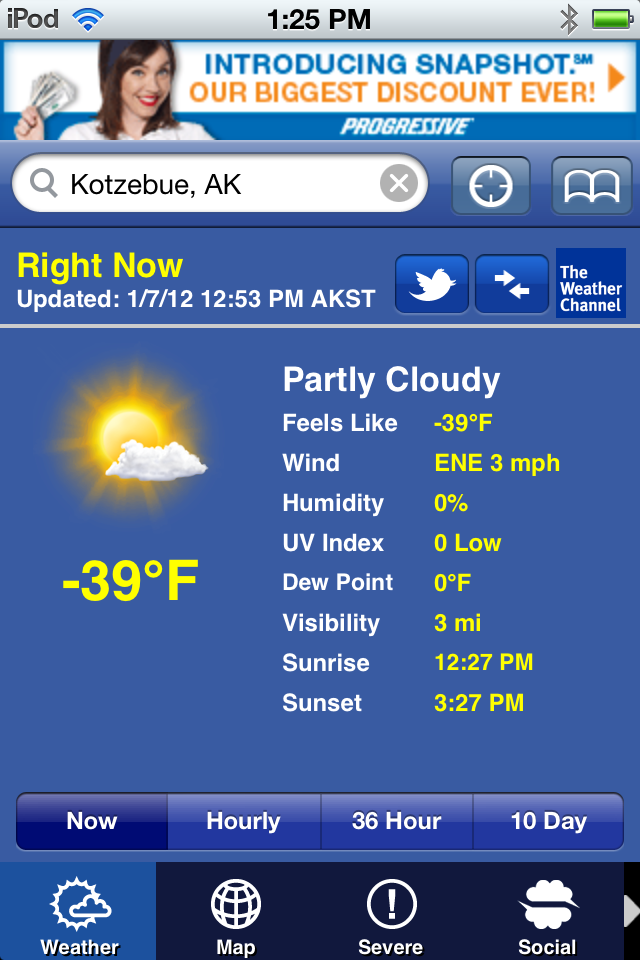
It did get a little colder than this screen shot, but this was the closest one I captured. That day, at that moment, the wind was calm, but it's amazing how much of an effect wind chill has. I have a much better understanding of it having lived up here. (I've come a long way from when I was a kid and thought people were calling it the "windshield factor." Hey, it makes sense...the windshield of the car on a cold day tends to feel colder than the air feels to the touch!)
When you get temperatures this cold, things do start to happen. Materials react differently. Clothing that once seemed to be the warmest feels like you're wearing next to nothing. Travel becomes more dangerous. So you start to see weather warnings like this one. I especially like the part that says "exposed flesh will freeze in less than 10 minutes." I wear mittens most of the time because they keep your fingers warmer, but it's hard to get your keys out of your pocket, find the right key, and open the door with them. So, I take off my mitten, get keys with bare hand, and open the door. It's really no big deal. It's not like you're standing around in liquid nitrogen. But after reading this, I sometimes laugh at myself because I hurry just a bit more to get the key in the door and get it open!
Another thing that happens at around -40 F is ice fog. Water freezes at 32 F, right? Well, not always. If it doesn't have a nucleating agent -- some kind of molecule that encourages and ice crystal to form around it -- water can become supercooled. It's still in liquid form with a temperature below its freezing point. However, at around -40 F, even the cleanest, purest water will freeze. Cold air can't hold as much water as warm air, and at -40 F, saturated air "squeezes out" its water vapor as liquid or ice crystals. The fog that forms is called ice fog. In places like Fairbanks where you get temperature inversions and there's pollution from cars (giving something for the ice to nucleate on), ice fog will form at warmer temperatures of around -20 F. Here are a couple of pictures. Of course, they just look like any old fog, but now you know what causes it! The one with the sun was taken close to 2:00 which is about noon -- when the sun is highest in the sky -- for us, so you can see how low it still is. We're gaining 7 minutes a day, though, and tomorrow we'll be up to a 4 hour day!
It seems to me that on a bright, calm day, the minus teens or even down to -20 F can be quite comfortable. Towards -30 F is chilly but bearable. Drop to -40 F and throw in some wind, and you spend a considerable portion of your day planning out your dress and routine -- at least I do -- and you might even postpone some errands for a while. Based on my experience during the last two winters, that strategy would work. If it was very cold or very windy (thus making it feel much colder), you might wait a day or two, and then the weather would be nice again. Well, for the past few weeks we've had temperatures staying steadily around -25 F to -35 F with varying wind chills, and a few days with - 40 F or less.
It did get a little colder than this screen shot, but this was the closest one I captured. That day, at that moment, the wind was calm, but it's amazing how much of an effect wind chill has. I have a much better understanding of it having lived up here. (I've come a long way from when I was a kid and thought people were calling it the "windshield factor." Hey, it makes sense...the windshield of the car on a cold day tends to feel colder than the air feels to the touch!)
Another thing that happens at around -40 F is ice fog. Water freezes at 32 F, right? Well, not always. If it doesn't have a nucleating agent -- some kind of molecule that encourages and ice crystal to form around it -- water can become supercooled. It's still in liquid form with a temperature below its freezing point. However, at around -40 F, even the cleanest, purest water will freeze. Cold air can't hold as much water as warm air, and at -40 F, saturated air "squeezes out" its water vapor as liquid or ice crystals. The fog that forms is called ice fog. In places like Fairbanks where you get temperature inversions and there's pollution from cars (giving something for the ice to nucleate on), ice fog will form at warmer temperatures of around -20 F. Here are a couple of pictures. Of course, they just look like any old fog, but now you know what causes it! The one with the sun was taken close to 2:00 which is about noon -- when the sun is highest in the sky -- for us, so you can see how low it still is. We're gaining 7 minutes a day, though, and tomorrow we'll be up to a 4 hour day!
![]() |
| Ice Fog |
| Sun burning through ice fog at high noon |
Wednesday, December 28, 2011
Work, Work, Work
I've been made aware that I'm letting my (very small) readership down. I'm not sure why I haven't been getting around to writing lately. I tend to blame it on work, but I obviously haven't been working nonstop for almost 3 months, so let's just call it a slump, and I'll try to move on.
Actually, a fair chunk of that silent period was work. I had a very busy fall. I was looking at my numbers the other day, and so far this fiscal year (since Oct. 1), I've already had contact with around 1000 students. In November I gave 44 "programs." So, what is it that this park ranger really does?
A program is what we call a lesson, presentation, talk, etc. During the school year, my programs are usually about an hour long and are in a classroom with one class at a time. The teachers contact me, sign up for a date / time and ask for a certain topic, usually from a list of topics I give them as suggestions. Then, I use a lesson plan we already have prepared for that topic and age group, or I write one if we don't have one made. Of course, since I work for the Park Service, our lessons have to benefit our own mission, so they have something to do with conservation or education about the natural and cultural resources of our parks here. Locations / names of parks, park and park service history, careers in the park service, and parks for personal enjoyment are also themes in our lessons. I tend to get most interest from the elementary teachers here in Kotzebue, so I might return to a given class 3 or 4 times during the school year. Often though, especially if I'm traveling to a village, I only have one opportunity to work with a certain group of children that year, so our lessons are meant to be fun, active and engaging. Since this is my third school year, many of the elementary and middle school kids know me, and they're always really excited when I visit. Sometimes the teachers will have them write thank-you letters, and they can be rewarding and pretty entertaining too. Some kids say some pretty funny things! I'll post some program-related things below...they may not be about the same one.
The little kids here (anywhere really) are just adorable. The tiny ones are "all up in your grill" as they say, and it can be difficult trying to to make them feel bad as you shake them off! Going into this job, I knew I would be contacting kids of all ages from all over the region, throughout the winter in the Arctic. I assumed it was a recipe for illness! To my surprise, my first (just about) two years were without incident. Then this spring I got strep throat in Kobuk, and this fall I got a nasty stomach bug in Kivalina. I'm hoping that will be all for a while.
Kids love to move. I think they sit still way too much in school as it is, so many of our programs incorporate lots of movement. One of the best for that is the lesson on the history of sled dogs, and an activity that the kids love is becoming a team of sled dogs themselves. I just have them grab onto a rope, paired up like the formations they use here, and I give them the directional commands: hike (go), gee (turn right), haw (turn left), come gee (180 to the right), come haw (180 to the left), easy (slow down), let's go (speed up), on by (ignore whatever's on the trail), whoa (stop). At this age, following directions of any kind can be a challenge, so you can imagine that this can get fairly animated!
Some programs include a little bit of art (not my strength). This is a short, simple art project I sometimes do after learning about the northern lights.
When I first got here I thought kids probably weren't impressed with natural things: skulls, bones, fur, preserved animals, etc. I imagined they got to see and handle plenty of things as their families hunted. I was wrong. They always love it, even common animals such as caribou. The encased bird there is a yellow-billed loon. It's not listed, but it's a species of concern because of specific habitat requirements and low nesting population. Loons in general are really cool animals. Here's a fact sheet from US Fish & Wildlife. Take a look. Try to find a loon call online. It's eerie!! This picture was earlier this month in Noatak. That loon was donated to the NPS after getting caught in a fishing net. Now it stays on display at our visitor center in Kotzebue, except when it travels with me to another school.
The next few things are all related to a program I did in October with Kotzebue 5th graders. It was about owls and food webs. I read them a story where they imagine they're turning into an owl. They hunt, eat, and at the end throw up a pellet. That introduces the idea of what an owl pellet is and that it has leftover pieces of what owls eat. By examining a pellet we can learn what owls eat and see how they connect to other animals in the food web, yada, yada, yada... As I explain that they'll each be dissecting a pellet, I tell them that theirs are from a company that sells barn owl pellets, they've been sterilized, etc., and I unwrap and take a bite of an owl pellet cookie. Of course they freak out thinking it's real, but they get over it when they get their own cookie to eat! Then they measure and dissect their pellets. They try to classify the kinds of bones they find & figure out what kind of animal it was. This part takes a little while, and while they're working, I replay a little "video" I made. It started as laminated photos and this year has made it to video with English and Inupiaq names as well as the owls' calls. The kids really enjoyed it. I'm not sure why, but the slides don't line up correctly with the sound in this uploaded video. In the real one it does, so just pay attention as it goes. Each one is: name in English, Inupiaq name, bird call...
This program is always a hit as well. One of the 5th grade teachers had her students write thank you letters, and here's one I thought was particularly priceless!
Actually, a fair chunk of that silent period was work. I had a very busy fall. I was looking at my numbers the other day, and so far this fiscal year (since Oct. 1), I've already had contact with around 1000 students. In November I gave 44 "programs." So, what is it that this park ranger really does?
A program is what we call a lesson, presentation, talk, etc. During the school year, my programs are usually about an hour long and are in a classroom with one class at a time. The teachers contact me, sign up for a date / time and ask for a certain topic, usually from a list of topics I give them as suggestions. Then, I use a lesson plan we already have prepared for that topic and age group, or I write one if we don't have one made. Of course, since I work for the Park Service, our lessons have to benefit our own mission, so they have something to do with conservation or education about the natural and cultural resources of our parks here. Locations / names of parks, park and park service history, careers in the park service, and parks for personal enjoyment are also themes in our lessons. I tend to get most interest from the elementary teachers here in Kotzebue, so I might return to a given class 3 or 4 times during the school year. Often though, especially if I'm traveling to a village, I only have one opportunity to work with a certain group of children that year, so our lessons are meant to be fun, active and engaging. Since this is my third school year, many of the elementary and middle school kids know me, and they're always really excited when I visit. Sometimes the teachers will have them write thank-you letters, and they can be rewarding and pretty entertaining too. Some kids say some pretty funny things! I'll post some program-related things below...they may not be about the same one.
The little kids here (anywhere really) are just adorable. The tiny ones are "all up in your grill" as they say, and it can be difficult trying to to make them feel bad as you shake them off! Going into this job, I knew I would be contacting kids of all ages from all over the region, throughout the winter in the Arctic. I assumed it was a recipe for illness! To my surprise, my first (just about) two years were without incident. Then this spring I got strep throat in Kobuk, and this fall I got a nasty stomach bug in Kivalina. I'm hoping that will be all for a while.
![]() |
| Kids as "sled dogs" |
![]() |
| Actual sled dogs |
Some programs include a little bit of art (not my strength). This is a short, simple art project I sometimes do after learning about the northern lights.
When I first got here I thought kids probably weren't impressed with natural things: skulls, bones, fur, preserved animals, etc. I imagined they got to see and handle plenty of things as their families hunted. I was wrong. They always love it, even common animals such as caribou. The encased bird there is a yellow-billed loon. It's not listed, but it's a species of concern because of specific habitat requirements and low nesting population. Loons in general are really cool animals. Here's a fact sheet from US Fish & Wildlife. Take a look. Try to find a loon call online. It's eerie!! This picture was earlier this month in Noatak. That loon was donated to the NPS after getting caught in a fishing net. Now it stays on display at our visitor center in Kotzebue, except when it travels with me to another school.| Owl pellet cookies (no bake cookies made to look like owl pellets) |
| Student dissecting real owl pellet |
This program is always a hit as well. One of the 5th grade teachers had her students write thank you letters, and here's one I thought was particularly priceless!
Saturday, October 8, 2011
Saturday, Snow & Shopping
First of all, hurrah for Saturday of a three-day weekend! It's off to a pretty start, too. This is what I saw from the window this morning:
Except for, perhaps, when the fireweed is in full bloom, Kotzebue is prettiest when there's a layer of freshly fallen snow over everything! I was wondering when it would snow. Actually, it did snow just a little earlier this week, Thursday morning, I think, but it didn't cover the ground and was gone by mid morning. However, even that seemed late. Of course, I'm only going into my third winter here, but based on what other people say, the first snowfall usually happens in September. Not this year. I was trying to find some historic weather data for Kotzebue, but was unsuccessful. I did find some interesting summaries for Anchorage. I think Kotz would be fairly different, though. There would be a lag in temps and begin/end dates, for sure. Anchorage probably gets much more snowfall as well. The amount of snowfall in Kotzebue isn't much. We meet the definition of a cold desert, a desert having < 9 inches annual precipitation. Just for reference, though, here's what I found for earliest and latest dates for first snowfall in Anchorage. The entire page can be seen here.
Now I have to take advantage of this Saturday of a three-day weekend and use those hangers to do some long-awaited cleaning and organizing. This snow won't stick around, but it's usually here for good before Halloween, and I have to be able to get to my boots and snow pants!
Except for, perhaps, when the fireweed is in full bloom, Kotzebue is prettiest when there's a layer of freshly fallen snow over everything! I was wondering when it would snow. Actually, it did snow just a little earlier this week, Thursday morning, I think, but it didn't cover the ground and was gone by mid morning. However, even that seemed late. Of course, I'm only going into my third winter here, but based on what other people say, the first snowfall usually happens in September. Not this year. I was trying to find some historic weather data for Kotzebue, but was unsuccessful. I did find some interesting summaries for Anchorage. I think Kotz would be fairly different, though. There would be a lag in temps and begin/end dates, for sure. Anchorage probably gets much more snowfall as well. The amount of snowfall in Kotzebue isn't much. We meet the definition of a cold desert, a desert having < 9 inches annual precipitation. Just for reference, though, here's what I found for earliest and latest dates for first snowfall in Anchorage. The entire page can be seen here.
My neighbor is into yard sales and always finds out if there are any and where to they are (addresses are a different animal here; I'll write on that another time). Last week there were none, and I thought with the weather getting colder, and now with snow starting to fall, that we had probably seen the last of them until spring. Space is a premium here, though, so if you have to get rid of things, you find a way. There were, indeed two sales. One was inside. I got a little knife for free that I'll add to my survival kit. The other one was outside, and I picked up a few hangers.
Now I have to take advantage of this Saturday of a three-day weekend and use those hangers to do some long-awaited cleaning and organizing. This snow won't stick around, but it's usually here for good before Halloween, and I have to be able to get to my boots and snow pants!
Here We Are Again
It's that time of year again. I'm traveling to villages; the goal is 9 or 10 within the school year. I've done 2 so far and will have 3 more before Christmas. This is my 3rd year, and I'm getting more and more requests. My first visit this year was to Kiana, which also happened to be one of the later visits last school year, so I was just there this spring. It was nice to get to see the village during different seasons.
On this visit, the teachers asked me to stay the whole week. I arrived Monday, at a very busy time as you can see from the crowded airport picture below, and stayed through Friday evening.
I had probably missed the really pretty fall colors by several weeks, but there was plenty of pretty green and gold contrast with the spruce and paper birch.
Kiana has an interesting history. It's situated where the Squirrel and Kobuk rivers come together. The name came from the Inupiaq word Qayaana, which to my best understanding refers to a point of land across the river from the village. The natives tended to call the place Katyaak which means where the rivers meet, but English speaking folks around 1900 heard them saying, "qayaana katyaak," and called it Kiana. There's a neat website with lots of cultural info about Kiana. Go to Kiana Jukebox to learn more about Kiana.
The reason there were lots of English-speaking people in Kiana around 1900 is a story in itself. You might know that was during the time of gold rushes all around Alaska, the biggest being the Klondike (in Canada but accessed through AK). Shortly after the Klondike rush, it was reported that gold was found on the Kobuk, and about 2000 prospectors arrived to Kotzebue in July, 1898. When they arrived, locals informed them that the rumors were lies, and over half turned around and went home. About 800, however, made their way upriver and spent the winter. They didn't find anything, but eventually there was some gold found over the next 10 years in a few tributaries of the Kobuk, including Squirrel River, which joins the Kobuk right at Kiana. To read more, start at this NPS website.
Here are a few more pictures to enjoy:
On this visit, the teachers asked me to stay the whole week. I arrived Monday, at a very busy time as you can see from the crowded airport picture below, and stayed through Friday evening.
I had probably missed the really pretty fall colors by several weeks, but there was plenty of pretty green and gold contrast with the spruce and paper birch.
Kiana has an interesting history. It's situated where the Squirrel and Kobuk rivers come together. The name came from the Inupiaq word Qayaana, which to my best understanding refers to a point of land across the river from the village. The natives tended to call the place Katyaak which means where the rivers meet, but English speaking folks around 1900 heard them saying, "qayaana katyaak," and called it Kiana. There's a neat website with lots of cultural info about Kiana. Go to Kiana Jukebox to learn more about Kiana.
The reason there were lots of English-speaking people in Kiana around 1900 is a story in itself. You might know that was during the time of gold rushes all around Alaska, the biggest being the Klondike (in Canada but accessed through AK). Shortly after the Klondike rush, it was reported that gold was found on the Kobuk, and about 2000 prospectors arrived to Kotzebue in July, 1898. When they arrived, locals informed them that the rumors were lies, and over half turned around and went home. About 800, however, made their way upriver and spent the winter. They didn't find anything, but eventually there was some gold found over the next 10 years in a few tributaries of the Kobuk, including Squirrel River, which joins the Kobuk right at Kiana. To read more, start at this NPS website.
Here are a few more pictures to enjoy:
| Kiana Lynx gym |
Friday, September 23, 2011
Mosquito Haven 1/2 Marathon
Last December I made a decision to alter my habits and drop some weight. I stopped drinking any sodas (called pop here), spent more time in my kitchen, and started working out. I didn't dive into it by any means. The food from my kitchen wasn't necessarily your typical diet food, but I controlled my portions. As often as I could, I logged it in some software that tracks nutrition, weight, and workout info. The workouts started with just walking, and not super fast at that. Little by little, I cranked up the workouts. The food was always hit or miss, but I did go for months without eating out. The weight was dropping steadily. Around the new year, I decided that I would resolve to run in the annual Mosquito Haven Half Marathon held here in early August. There was a lot of work to do to get ready. I did start running and was getting much better. Of course, this was on the treadmill because it was the middle of winter. As spring thaw arrived and I started running on gravel, I realized I had much more work to do! The hills and the gravel take much more energy than the treadmill.
Then summer arrived. The school year is busy enough, but it seems that there is indeed a trend for an even busier summer. You would think I would be able to be more active and lose more in the summer, but between a busy work schedule (which leads you to eat quick, easy, calorie laden food) and doing things that are outdoors but not physically demanding (going to a cookout on the beach, berry picking, etc.) you run out of time to dedicate to fitness. I noticed quickly that I was putting some weight back on. I was disappointed but still determined to keep my resolution.
People can participate in the half marathon by walking, biking or running. Anyone who participates receives a light jacket like this one. At the end they also give prizes to the first finisher in each category by age class, and there's a raffle for lots of other prizes.
I decided well before the event that I was not in shape to run it this year, but I could still walk it and work on running it next year. So, I did walk. About two thirds of the way through I caught myself thinking that even if I hadn't undone much of my hard work during the summer, I still would not have been able to run it yet. Thirteen plus miles on gravel and hills is not easy!
So, walk it I did. There's the proof, and there's my time. Unfortunately, throughout the rest of August I continued to undo my work. The first two weeks of August were so busy with organizing our Camp Willow (which fell through due to weather this year -- very disappointing), the last couple of Junior Ranger programs, working on a teacher workshop and being available during teacher inservice. I found myself pulling a couple of all-nighters just to get things done.
After two weeks of "vacation" (just kidding PEL & MEL!), I came back to dive into school programs and village visits. The first, Kiana, asked me to stay the entire week. That's great. That means I have something they're looking for. However, it's not easy to be healthy on these trips. I stay in the school. I might have access to a fridge or a place to cook something. However, I have to travel as light as I can because I'm hauling boxes of props and program materials, so I can't bring my whole kitchen with me. Whatever I take has to be lightweight, compact, and able to withstand being thrown around in the back of a little plane. It's usually something like jerky, crackers and cheese. This time I took some tuna packets and pilot bread.
The room I stayed in this year in Kiana looked like this:
It had been turned into a fitness room. I thought that might be a big hint! I did have time to use the equipment. However, since I try to pack light, I usually only take 1 uniform, 1 change of clothes for the evening, and I wear my uniform boots the whole time. This room was originally a special ed room, and it has a bathroom with a shower off of it, so I could take a shower, but there's no way to wash and dry clothes. So, I didn't use the equipment.
Now I've been back in Kotz for the week, and I'm leaving for Noorvik on Monday. That's the way it will be the majority of the school year. Travel and in town on and off. I know what I can do, though. I felt and looked so much better earlier this year. I just have to pick one of these days and make a choice. It might as well be TODAY. So, first steps: 1) stop the sodas effective immediately, water consumption must increase 2) going to the gym starts tomorrow morning 3) by the time I return from Noorvik, the eating out will be at a minimum.
If you're so inclined, make your own good choice with me!
Then summer arrived. The school year is busy enough, but it seems that there is indeed a trend for an even busier summer. You would think I would be able to be more active and lose more in the summer, but between a busy work schedule (which leads you to eat quick, easy, calorie laden food) and doing things that are outdoors but not physically demanding (going to a cookout on the beach, berry picking, etc.) you run out of time to dedicate to fitness. I noticed quickly that I was putting some weight back on. I was disappointed but still determined to keep my resolution.
People can participate in the half marathon by walking, biking or running. Anyone who participates receives a light jacket like this one. At the end they also give prizes to the first finisher in each category by age class, and there's a raffle for lots of other prizes.
I decided well before the event that I was not in shape to run it this year, but I could still walk it and work on running it next year. So, I did walk. About two thirds of the way through I caught myself thinking that even if I hadn't undone much of my hard work during the summer, I still would not have been able to run it yet. Thirteen plus miles on gravel and hills is not easy!
So, walk it I did. There's the proof, and there's my time. Unfortunately, throughout the rest of August I continued to undo my work. The first two weeks of August were so busy with organizing our Camp Willow (which fell through due to weather this year -- very disappointing), the last couple of Junior Ranger programs, working on a teacher workshop and being available during teacher inservice. I found myself pulling a couple of all-nighters just to get things done.
After two weeks of "vacation" (just kidding PEL & MEL!), I came back to dive into school programs and village visits. The first, Kiana, asked me to stay the entire week. That's great. That means I have something they're looking for. However, it's not easy to be healthy on these trips. I stay in the school. I might have access to a fridge or a place to cook something. However, I have to travel as light as I can because I'm hauling boxes of props and program materials, so I can't bring my whole kitchen with me. Whatever I take has to be lightweight, compact, and able to withstand being thrown around in the back of a little plane. It's usually something like jerky, crackers and cheese. This time I took some tuna packets and pilot bread.
The room I stayed in this year in Kiana looked like this:
It had been turned into a fitness room. I thought that might be a big hint! I did have time to use the equipment. However, since I try to pack light, I usually only take 1 uniform, 1 change of clothes for the evening, and I wear my uniform boots the whole time. This room was originally a special ed room, and it has a bathroom with a shower off of it, so I could take a shower, but there's no way to wash and dry clothes. So, I didn't use the equipment.
Now I've been back in Kotz for the week, and I'm leaving for Noorvik on Monday. That's the way it will be the majority of the school year. Travel and in town on and off. I know what I can do, though. I felt and looked so much better earlier this year. I just have to pick one of these days and make a choice. It might as well be TODAY. So, first steps: 1) stop the sodas effective immediately, water consumption must increase 2) going to the gym starts tomorrow morning 3) by the time I return from Noorvik, the eating out will be at a minimum.
If you're so inclined, make your own good choice with me!
Wednesday, September 7, 2011
Great Kobuk Sand Dunes
We flew to the Kobuk River in float planes that hold the pilot and up to 3 passengers. From a certain point on the river, we hiked south to the dunes.
From the river, you hike uphill a bit through spruce forest. It's fairly thick through part of the way, and there are patches of tussock tundra to cross. We took our time, looked around, and stopped frequently, and it took a little over 2 hours. Here are some shots along the way.
this!
Here are a few more pictures:
| The wall of sand |
| See the ripples? |
| quaking aspen |
| quaking aspen taking hold |
| looks flat, but it's not |
It was a really nice day out there. It drizzled on and off and was overcast and windy, but that kept the walk out nice and cool. During the summer, some people come up to float down the Kobuk River, so this is the kind of trip they could make. If you have the money, there are a couple of companies authorized to fly visitors to the dunes. You could either fly in on a float plane like we did or land on other places around the dunes with wheels. If you have the chance, it's worth it. Kobuk Valley National Park is one of the least visited national parks, so it's not something that most people will see.
Subscribe to:
Posts (Atom)